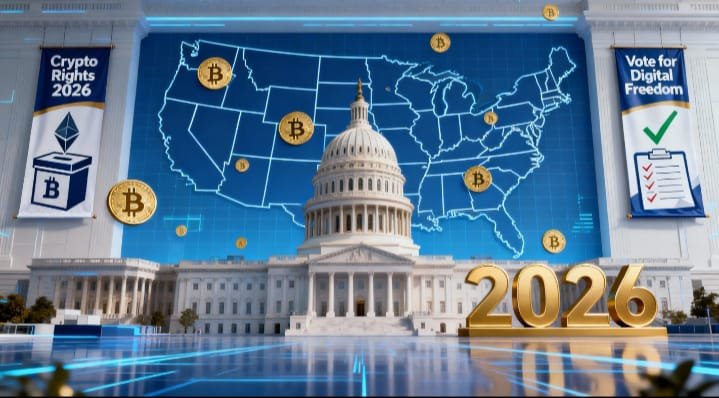

The Digital Chamber, one of the most influential voices for crypto advocacy in the United States, is expanding its mission beyond federal policymakers. With the 2026 midterm elections on the horizon, the organization has introduced a groundbreaking initiative known as the State Network—a comprehensive strategy aimed at shaping state-level crypto advocacy and empowering lawmakers outside Washington, D.C.
This move signals a major shift in how the crypto industry plans to engage with government bodies, especially as Congress advances new regulatory frameworks to bring more structure to digital asset markets.
Why State-Level Crypto Advocacy Matters More Than Ever
According to Cody Carbone, CEO of the Digital Chamber, the regulatory climate in Washington has become more receptive to digital assets over the last year. However, one major problem remains: U.S. states are not aligned on crypto rules, and their approach varies dramatically.
In an interview with The Block, Carbone emphasized that for the U.S. to lead in global crypto innovation, knowledge and policy expertise must exist at the state and local levels—not just on Capitol Hill.
“If we really want the U.S. to lead in crypto innovation, every state needs the right knowledge and tools to craft smart policies,” Carbone said.
For context, readers can explore the current federal regulatory landscape by reviewing the U.S. Congressional Digital Asset Legislation Tracker
Crypto’s Growing Political Influence in U.S. Elections
Crypto has quickly become a serious political force. In the 2024 election cycle, digital-asset-backed lobbying groups and super PACs invested millions in key races. A striking example is the $40 million spent in support of Republican Bernie Moreno, who defeated Democrat Sherrod Brown, widely regarded as one of the industry’s toughest skeptics.
By mid-2024, Fairshake, a leading crypto PAC, had already raised $141 million to shape election outcomes. Readers can verify these fundraising disclosures via the Federal Election Commission database
Digital Chamber to Support Pro-Crypto Candidates at All Levels
Looking ahead to 2026, Carbone confirmed that the Chamber will support pro-crypto candidates from Congress down to city councils and even school boards.
“Washington isn’t the only game in town anymore; the real action is moving to the states,” Carbone noted.
This decentralized electoral approach may reshape how local governments adopt blockchain, digital identity, smart contract frameworks, and token-based economic development initiatives.
Education & Legislative Training: A Core Pillar of the State Network
Crypto’s presence in federal hearings and regulatory conversations has surged, and now state lawmakers are seeking guidance. To address the information gap, the Chamber is partnering with Future Caucus, a nonpartisan organization committed to equipping young legislators with knowledge on emerging technologies.
Visit Future Caucus to explore their programs and mission.
Future Caucus president Layla Zaidane stated that state representatives are increasingly encountering real-world blockchain issues affecting:
- Financial inclusion
- Local fintech startups
- Digital identity and credential verification
- Smart city infrastructure
- Public sector transparency
This partnership will provide shared research and policy frameworks that state leaders can use when drafting digital asset regulation.
Grants for Blockchain Clubs & Local Innovation Hubs (2026 Launch)
Beyond policymaking, the State Network will introduce a blockchain innovation grants pilot in 2026. Funding will be available for:
- University blockchain and Web3 clubs
- State blockchain associations
- Regional technology accelerators
Anastasia Dellaccio, Executive Director of State and Regional Affairs, will lead this program and says its purpose is to empower grassroots crypto advocates working alongside policymakers.
“We’re proud to back groups that are helping leaders understand why solid, principled digital asset policy matters,” she explained.
Final Thoughts: A Turning Point for U.S. Crypto Regulation
The creation of the State Network marks one of the most ambitious pushes in state-level crypto advocacy to date. As digital asset usage grows—from Bitcoin ETFs and tokenized real-world assets to stablecoins and CBDCs—the states that adapt early could become the next hubs of blockchain innovation.
For businesses, investors, and crypto users, now is the time to watch state legislation as closely as federal policy.